
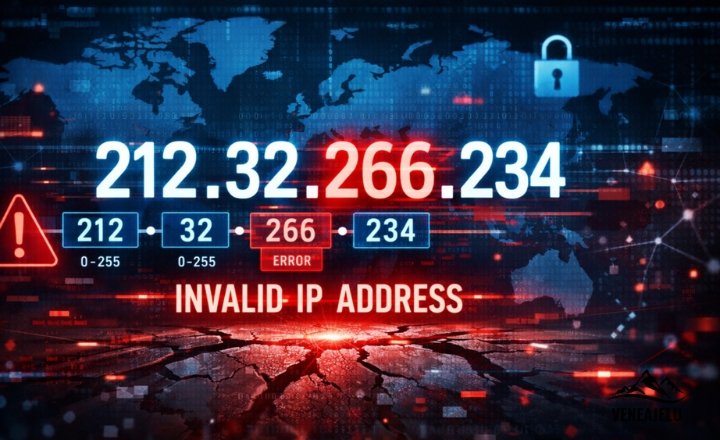
The IPv4 address 212.32.266.234 represents more than just a numerical string in dotted-decimal format. Within digital infrastructure, an IP address functions as a locator, identifier, and gateway to network interaction. Every server request, application handshake, email exchange, and data packet transmission relies on structured addressing systems that enable global communication.
Understanding 212.32.266.234 requires exploring its structural composition, routing logic, allocation context, cybersecurity considerations, performance implications, and administrative relevance. This address exists within the broader IPv4 ecosystem, where numerical precision governs how systems identify, authenticate, and exchange data across interconnected networks.
Structural Composition and Addressing Logic
IPv4 addresses are built on a 32-bit numeric system divided into four octets. Each octet ranges from 0 to 255. The address 212.32.266.234 follows this format:
- First octet: 212
- Second octet: 32
- Third octet: 266
- Fourth octet: 234
From a strict IPv4 compliance perspective, it is important to note that valid octet ranges fall between 0 and 255. Therefore, an octet value of 266 exceeds the allowable IPv4 boundary. This makes 212.32.266.234 technically invalid under standard IPv4 formatting rules.
This discrepancy opens discussion in several possible directions:
- Typographical error in address logging
- Data obfuscation or masking
- Synthetic or placeholder IP reference
- Malformed entry in traffic logs
- Deliberate formatting anomaly for testing or filtering systems
When evaluating network records or cybersecurity events, malformed IP structures like 212.32.266.234 often indicate either corrupted data entries or intentional manipulation.
Allocation Context and Global Address Space
Public IPv4 addresses are distributed through regional internet registries (RIRs). These organizations allocate address blocks to internet service providers and enterprise networks.
The prefix 212.x.x.x typically falls within ranges historically assigned to European regions under RIPE NCC management. However, since 212.32.266.234 contains an invalid octet, it would not exist within official routing tables.
This distinction is important for administrators and analysts:
- Valid addresses appear in global routing tables (BGP announcements).
- Invalid addresses never propagate through legitimate internet routing systems.
- Traffic logs referencing invalid IPs may signal malformed packets or spoofing attempts.
In professional environments, detecting malformed IP addresses is part of maintaining clean log integrity and ensuring filtering systems are properly configured.
Network Routing and Packet Behavior
When a device sends data to an IP address, the routing process includes:
- DNS resolution (if a domain is involved)
- Packet encapsulation
- Gateway transmission
- Router-based path determination
- Delivery to the destination subnet
If a system attempts to route traffic to 212.32.266.234, the routing mechanism would fail because the address violates IPv4 standards. Routers rely on binary validation rules; any octet exceeding 255 cannot be processed correctly in a 32-bit structure.
Possible outcomes include:
- Immediate rejection by networking stack validation
- Firewall discard during packet inspection
- Application-layer error reporting
- Log recording of malformed destination
Modern operating systems validate IP format before sending packets, meaning a request to 212.32.266.234 would typically not leave the host machine.
Cybersecurity Implications
Malformed IP addresses like 212.32.266.234 frequently appear in cybersecurity investigations. They may surface in:
- Web server logs
- Intrusion detection system alerts
- Spam header metadata
- Firewall rejection records
- SIEM dashboards
Security teams analyze irregular IP formatting for several reasons:
1. Log Poisoning Attempts
Attackers sometimes insert invalid IPs into logs to disrupt analysis systems or automated parsers.
2. Obfuscation Techniques
Certain scripts may generate impossible IP addresses to mask the origin of malicious traffic.
3. Testing and Reconnaissance
Security researchers occasionally use synthetic addresses to test validation filters.
4. Data Corruption Events
System errors during log storage may alter numerical values.
In professional cybersecurity environments, detection rules are often configured to flag:
- Octets exceeding 255
- Non-numeric characters in IP fields
- Truncated dotted-decimal strings
- Hex-encoded IP misinterpretations
The presence of 212.32.266.234 in logs should prompt verification rather than immediate attribution.
Binary Representation and Validation
To understand why 212.32.266.234 fails IPv4 validation, examining binary conversion helps.
Each IPv4 octet converts to 8-bit binary. The maximum value (255) equals:
11111111
The decimal value 266 would require more than 8 bits:
266 in binary = 100001010
This is 9 bits, exceeding IPv4 octet limits. Therefore:
- IPv4 strictly enforces 8-bit boundaries per octet
- Values above 255 cannot be encoded
- Routers cannot interpret overflowed octets
This technical limitation is foundational to IP addressing architecture.
Log Analysis Perspective
From a system administration standpoint, encountering 212.32.266.234 in logs requires structured investigation.
Step 1: Validate Log Source
Confirm whether the data originated from:
- Reverse proxy
- Web application firewall
- Application layer logging
- Load balancer
- CDN reporting layer
Step 2: Inspect Raw Packet Data
If packet capture (PCAP) exists, review whether:
- The IP was truncated
- The third octet was misparsed
- Byte misalignment occurred
Step 3: Correlate Timestamps
Cross-reference with:
- Server error logs
- Authentication attempts
- API request failures
- Suspicious traffic bursts
Step 4: Determine Risk Level
If the malformed IP appears frequently, it may indicate:
- Automated bot scanning
- Exploit script malfunction
- Input validation weakness
- Intentional injection attempt
Systematic evaluation ensures no real threat hides behind malformed entries.
Server Configuration and Filtering Controls
Robust systems implement input validation layers that automatically reject malformed IP addresses like 212.32.266.234.
Effective defensive configurations include:
- Strict regex validation for IP input fields
- Firewall rules enforcing IPv4 format compliance
- Application-layer numeric boundary checks
- Reverse proxy sanitization policies
- Centralized logging normalization
Example of validation logic:
- Accept only four octets
- Each octet must be numeric
- Each value must fall between 0 and 255
Without such validation, malformed IPs could disrupt analytics dashboards or automated threat scoring.
DNS and Reverse Lookup Behavior
DNS systems cannot resolve 212.32.266.234 because:
- It is not a routable IPv4 address
- PTR (reverse DNS) queries require valid octet formatting
- DNS servers reject invalid query structures
Attempting reverse lookup would produce immediate failure. DNS infrastructure depends on accurate numerical input, and malformed entries terminate at validation checkpoints.
Cloud and Hosting Environment Considerations
In cloud platforms such as AWS, Azure, or Google Cloud, IP address assignment follows strict validation protocols. An address like 212.32.266.234 would never be provisioned.
Cloud networking systems enforce:
- Automated IP range validation
- Subnet mask compliance
- CIDR notation alignment
- Conflict detection before deployment
If 212.32.266.234 appears within cloud logs, it likely originates from:
- User-supplied request headers
- X-Forwarded-For spoofing attempts
- Misconfigured logging templates
- Application-level input corruption
Cloud administrators should always verify whether the malformed value entered via HTTP header manipulation.
Potential Misinterpretation Scenarios
Several technical scenarios can generate addresses resembling 212.32.266.234:
1. Byte Overflow in Custom Parsers
Improperly written scripts may fail to restrict integer boundaries.
2. CSV Column Shift
Data export errors can shift numeric values between fields.
3. Hexadecimal Conversion Error
If a system misreads hexadecimal input and converts incorrectly, octet inflation may occur.
4. Manual Entry Mistake
Human error during documentation or firewall rule entry.
Understanding these possibilities helps prevent misdiagnosis.
Threat Intelligence and Reputation Systems
IP reputation databases rely on valid routable addresses. Since 212.32.266.234 is invalid, it will not:
- Appear in abuse blacklists
- Be associated with ASN ownership
- Return geolocation data
- Produce WHOIS registration results
If a security tool reports geolocation for 212.32.266.234, it indicates flawed validation within that tool.
Professional-grade intelligence platforms validate IP structure before classification.
Application Development Perspective
Developers designing APIs, authentication systems, or logging pipelines should treat IP validation as foundational.
Best practices include:
- Server-side validation rather than client-side trust
- Rejecting malformed IP addresses at request boundary
- Using native networking libraries instead of custom parsing
- Normalizing X-Forwarded-For headers carefully
- Logging both raw and validated IP values
If an application stores 212.32.266.234, database schema design may lack constraints.
Data Integrity and Compliance Considerations
Regulatory frameworks often require accurate log retention. Storing invalid IP data could compromise:
- Incident response investigations
- Legal compliance audits
- Forensic traceability
- Security certification reviews
Organizations must ensure:
- Input sanitation at ingestion layer
- Automated anomaly detection in log pipelines
- Regular integrity audits
- Controlled log retention policies
Malformed IP addresses should be flagged and categorized appropriately.
Broader IPv4 Ecosystem Context
IPv4 exhaustion has driven adoption of IPv6, which uses 128-bit addressing. IPv6 eliminates many limitations of IPv4 but introduces different formatting standards.
Comparative overview:
- IPv4: 32-bit, dotted decimal
- IPv6: 128-bit, hexadecimal colon-separated
- IPv4 maximum per octet: 255
- IPv6 segments: 16-bit blocks
The invalidity of 212.32.266.234 reinforces how strictly IPv4 boundaries are defined. Any overflow breaks compatibility.
Practical Administrative Response Checklist
When encountering 212.32.266.234, administrators should:
- Verify log authenticity
- Check parsing scripts
- Inspect firewall reject logs
- Confirm no user input vulnerability
- Document anomaly classification
- Monitor for repetition patterns
Proactive documentation prevents confusion during future audits.
Performance and Monitoring Systems
Monitoring dashboards that fail to validate IP formats may display inaccurate metrics. This can lead to:
- Skewed geographic reports
- Incorrect traffic origin analysis
- False threat mapping
- Broken visualizations
Modern analytics platforms integrate validation layers before processing address data.
If 212.32.266.234 bypasses validation and enters analytics pipelines, visualization tools may crash or misrender data points.
Digital Forensics Perspective
Forensic investigations depend heavily on IP traceability. An invalid IP address such as 212.32.266.234 immediately signals one of three conditions:
- Log corruption
- Intentional deception
- Parsing malfunction
Forensic analysts prioritize authenticity verification before attributing suspicious behavior.
Chain-of-custody protocols require confirming:
- Original log source integrity
- Time synchronization accuracy
- Storage medium reliability
- Hash validation of stored records
Invalid IP entries are treated as artifacts rather than actionable origin points.
Educational and Testing Applications
Synthetic IP addresses are sometimes used in documentation, labs, and sandbox environments.
However, standard practice uses reserved ranges such as:
- 192.0.2.0/24 (documentation)
- 198.51.100.0/24
- 203.0.113.0/24
Using 212.32.266.234 in educational materials could unintentionally create confusion because it violates IPv4 standards. Proper reserved documentation ranges prevent accidental real-world overlap.
Strategic Takeaways
The presence of 212.32.266.234 highlights several important principles:
- IPv4 enforces strict 0–255 octet boundaries
- Malformed addresses cannot route through the public internet
- Validation controls are critical for security and analytics
- Invalid IP entries often indicate parsing or injection anomalies
- Professional environments must detect and categorize malformed inputs
Rather than representing a live host or active server, 212.32.266.234 serves as an example of how structured addressing systems demand precision.
Final Technical Perspective
Digital infrastructure depends on numerical accuracy. Every router, firewall, DNS server, application framework, and monitoring tool assumes strict adherence to protocol standards. When an address such as 212.32.266.234 appears, it stands outside those standards.
That deviation is not merely a formatting issue; it is a signal.
It signals the need for:
- Rigorous validation
- Careful log interpretation
- Defensive configuration
- Structured investigation
- Data integrity awareness
IP addressing is foundational to global connectivity. Even a single octet exceeding its boundary renders an address nonfunctional within the IPv4 universe.
Understanding why 212.32.266.234 cannot exist in routable space strengthens comprehension of how networking truly operates — with binary discipline, strict protocol enforcement, and zero tolerance for overflow.
Read More: suhmoraes706